Original Publication: The Riding Horse Magazine, (Ridehesten.com)
Publication Date: February 2017 (02/2017)
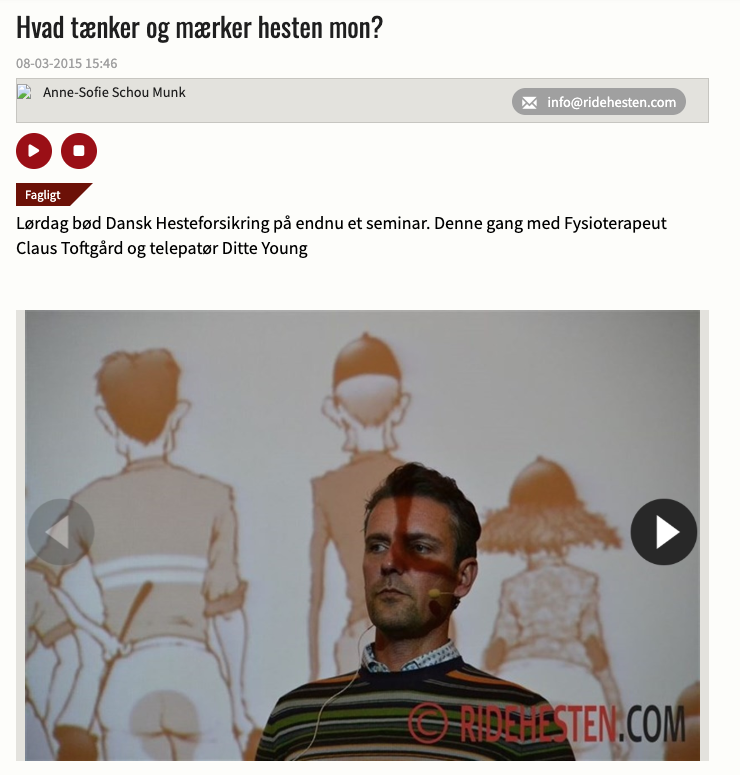
Ditte focuses on the mental challenges that can arise between horse and rider, while Claus, a physical therapist and acupuncturist, addresses the physical aspects of their partnership.
Ditte begins by briefly explaining how telepathy works and mentions that she is not a rider herself.
Ditte explains that horses need structure and clarity. Above all, however, she believes it is important for those of us who handle horses to be fully present in the moment and to recognize that horses pick up on our thoughts and emotions and react to them.
She gives an example: If, in your mind, you are already heading out into the woods as you mount your horse, the horse may start walking before you have even settled into the saddle. You then pull back on the reins and perhaps become frustrated. According to Ditte, this is where a misunderstanding can arise, because the horse has read your thoughts and is doing exactly what you asked.
Claus Toftgaard opens his presentation by explaining that he conducts these workshops, titled “What Is the Horse Thinking and Feeling?”, to improve horse welfare in Denmark, because he is “really not impressed by what he sees” when visiting stables and equestrian competitions.
Claus explains how a rider’s body should function and that it is much easier to correct the rider than the horse. Like Ditte, he emphasizes that although horses almost always have a natural tendency to favor either their left or right side, rider error most often causes problems. Claus believes healthy, happy horses have riders who understand both their own bodies and their horses’ bodies, and who can vary their training methods without sacrificing their chances of winning prizes at competitions.
After Ditte and Claus thoroughly assess the horse-and-rider pair, Sascha and Buddy, Claus offers several useful tips. Among other things, he recommends that if you tend to sit with your legs crossed, you should alternate which leg is on top to maintain better balance and symmetry.
To conclude the informative presentation, the audience is reminded that if they want to help their horses, they should always look at themselves first. “Our physical challenges affect our horses, too.”
“If we want our horses to move with fluidity, we need to move with fluidity ourselves.”

Sign up for my newsletter and receive the free animal telepathy course “10 tips for communicating telepathically with your animal”