Original Publication: The Horse Magazine (Hestemagasinet), Denmark
Publication Date: 2014
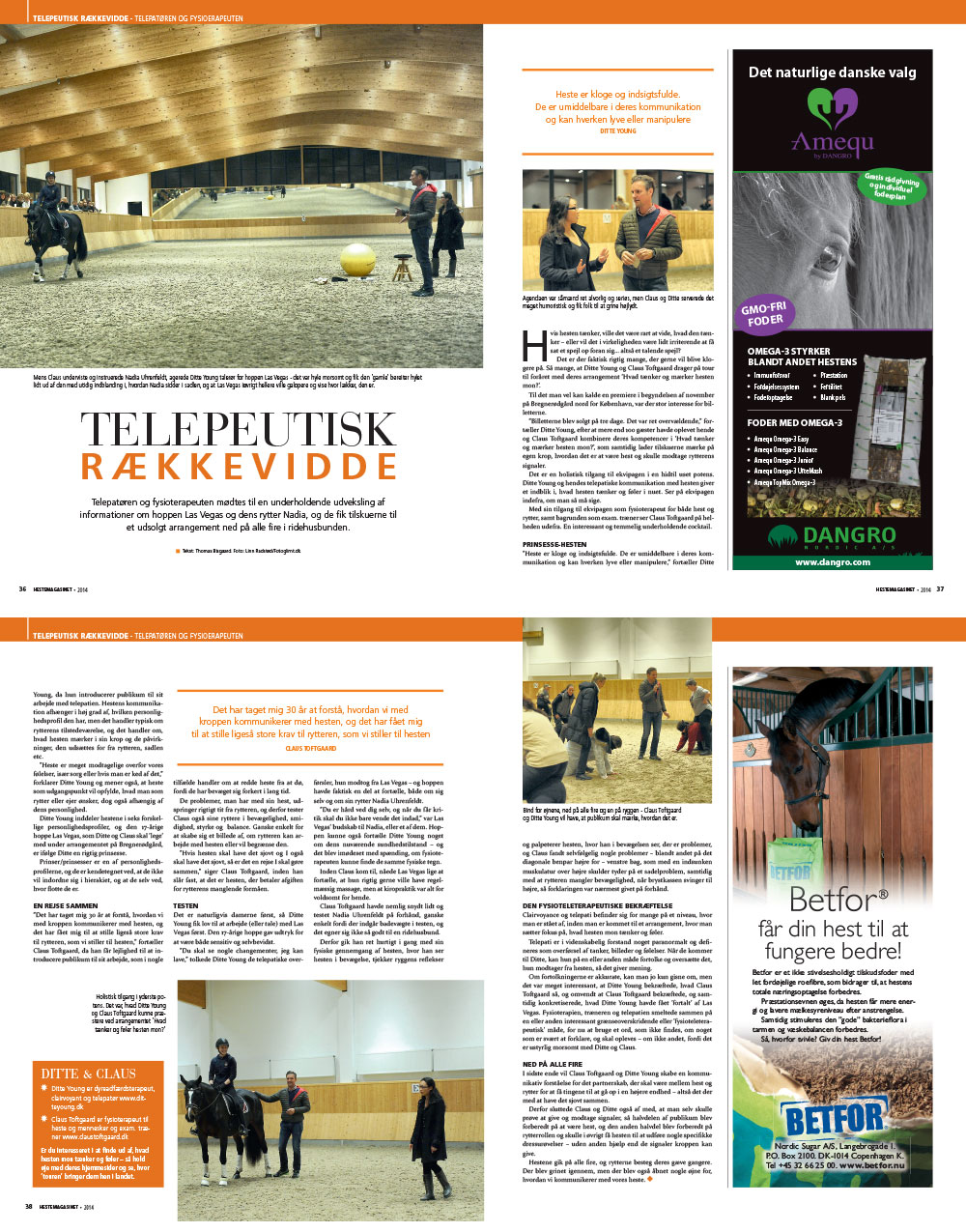
The telepath and the physiotherapist met for an entertaining exchange of information regarding the mare Las Vegas and her rider, Nadia—an encounter that had the audience at the sold-out event down on all fours on the arena floor.
Text: Thomas Bisgaard. Photo: Lars Rach/Fotografi.dk
Horses are intelligent and perceptive. They are direct in their communication and are incapable of lying or manipulation.
While Claus taught and instructed Nadia Uhrfeldt, Ditte Young acted as a mouthpiece for the mare, Las Vegas—a session that was anything but dull. She guided the participants to get down on the ground, offering insight into how Nadia sits in the saddle and revealing that Las Vegas would occasionally want to give up—specifically when she had something to communicate about her sore back.
This is a subject that many people are keen to learn more about—so many, in fact, that Ditte Young and Claus Toftgaard are taking their event, “What Might the Horse Be Thinking and Feeling?”, on tour.
For what could be described as a premiere—held in early November at Bregnerødgård, north of Copenhagen—there was significant demand for tickets.
“The tickets sold out in three days. It was quite overwhelming,” says Ditte Young, following an event where over 100 guests watched her and Claus Toftgaard combine their respective areas of expertise. The session, titled “What Might the Horse Be Thinking and Feeling?”, also allowed the audience to experience firsthand what it is like to be a horse and to receive signals from a rider. It is a holistic approach to the horse-and-rider combination, taken to an unprecedented level. Through her telepathic communication with the horse, Ditte Young offers insight into what the animal is thinking and feeling in the present moment—examining the pair from the inside, so to speak.
Claus Toftgaard, drawing on his background as a physiotherapist for both horse and rider—as well as his qualifications as a certified trainer—looks at the whole picture from the outside. It makes for an interesting and highly entertaining combination.
“Horses are intelligent and insightful. They are direct in their communication; they are incapable of lying or manipulation,” explains Ditte Young, as she introduces the audience to her work with telepathy.
A horse’s communication depends largely on its specific personality profile. Typically, it relates to the rider’s presence, as well as what the horse senses within its own body—including the influences exerted by the rider, the saddle, and so on.
“Horses are highly receptive to our emotions—especially grief or sadness,” Ditte Young explains. She adds that, generally speaking, horses want to fulfill the wishes of their rider or owner—though this, too, depends on the individual horse’s personality.
Ditte Young categorizes horses into six distinct personality profiles. According to her, the 17-year-old mare Las Vegas—with whom Ditte and Claus will be working during the event at Bregnerødgård—is a true “princess.”
“Princes” and “princesses” are one of these personality profiles; they refuse to conform to the established hierarchy and clearly recognize their own strength.
“It has taken me 30 years to understand how we communicate with the horse using our bodies, and this has led me to place just as high demands on the rider as we do on the horse.”
Claus Toftgaard gets the opportunity to introduce the audience to his work—work that, in some cases, involves saving horses from death caused by long-term incorrect movement.
Problems a horse has often stem from the rider; therefore, Claus also assesses his riders for mobility, flexibility, strength, and balance. Simply put, this lets him gauge whether the rider can work with the horse or will actually hinder it.
“If the horse is to enjoy itself—and if you are to enjoy yourselves, too—then it is a journey you must take together,” says Claus Toftgaard, adding that the horse pays the price for the rider’s lack of physical capability.
Naturally, the ladies go first, so Ditte Young was the first to work (or rather, converse) with Las Vegas. The 17-year-old mare appeared both sensitive and self-aware.
“You should see some of the flying changes I can perform,” Ditte Young said, interpreting the telepathic messages she received from Las Vegas. The mare, in fact, had quite a lot to share—both about herself and her rider, Nadia Uhrfeldt.
“You are too hard on yourself; when you receive criticism, you shouldn’t just turn it inward,” Las Vegas told Nadia—or at least one of them. The mare was also able to tell Ditte Young something about her current state of health—and there was eager anticipation as to whether the physiotherapist would be able to identify the same physical signs.
Before Claus stepped in, Las Vegas managed to convey that she would really appreciate regular massage, but that chiropractic treatment was far too intense for her.
As it happens, Claus Toftgaard had cheated a little and tested Nadia Uhrfeldt beforehand—simply because the assessment includes balance tests, which are not particularly well-suited for the surface of an indoor riding arena.
Consequently, he quite quickly began his physical assessment of the horse—observing it in motion, checking its spinal reflexes, and palpating its body—to identify where the issues lay.
Naturally, Claus discovered several problems—notably involving the diagonal pair of limbs (the right foreleg and left hind leg). Combined with muscle atrophy over the right shoulder, this pointed to a saddle-related issue. At the same time, the rider lacked mobility when the ribcage shifted to the right; thus, the explanation was essentially clear from the outset.
For many people, the concepts of clairvoyance and telepathy fall into a category that causes them to disengage well before they even reach an event focused on exploring what a horse might be thinking or feeling.
In scientific terms, telepathy is considered a paranormal phenomenon, defined as the transmission of thoughts, images, and emotions. When information reaches Ditte, she is somehow able to interpret and translate what she receives from the horse, rendering it meaningful.
While one can only speculate as to the accuracy of these interpretations, it was highly significant that Ditte Young’s findings aligned with Claus Toftgaard’s observations—and, conversely, that Claus Toftgaard confirmed and provided concrete detail regarding what Ditte Young had learned from Las Vegas. Physiotherapy, training, and telepathy merged in an intriguing, boundary-crossing—or perhaps “physio-tele-therapeutic”—way. I use a made-up term here because the concept is difficult to explain; it simply has to be experienced—if for no other reason than that Ditte and Claus are incredibly entertaining.
Ultimately, Claus Toftgaard and Ditte Young aim to foster a communicative understanding of the horse-and-rider partnership—one that brings everything together in perfect harmony and ensures both parties have fun.
To demonstrate this, Claus and Ditte invited the audience to try giving and receiving signals themselves. Half the audience took on the role of the “horse,” while the other half stepped into the role of the “rider”—tasked with guiding their “horse” through specific dressage movements using nothing but body signals.
The “horses” got down on all fours, and the “riders” mounted their spirited steeds.
There was plenty of laughter, but the session also opened eyes to how we communicate with our horses.
Sign up for my newsletter and receive the free animal telepathy course “10 tips for communicating telepathically with your animal”