
Original Publication: The Riding Horse Magazine (Ridehesten), Denmark
Publication Date: September 2015 (09/2015)
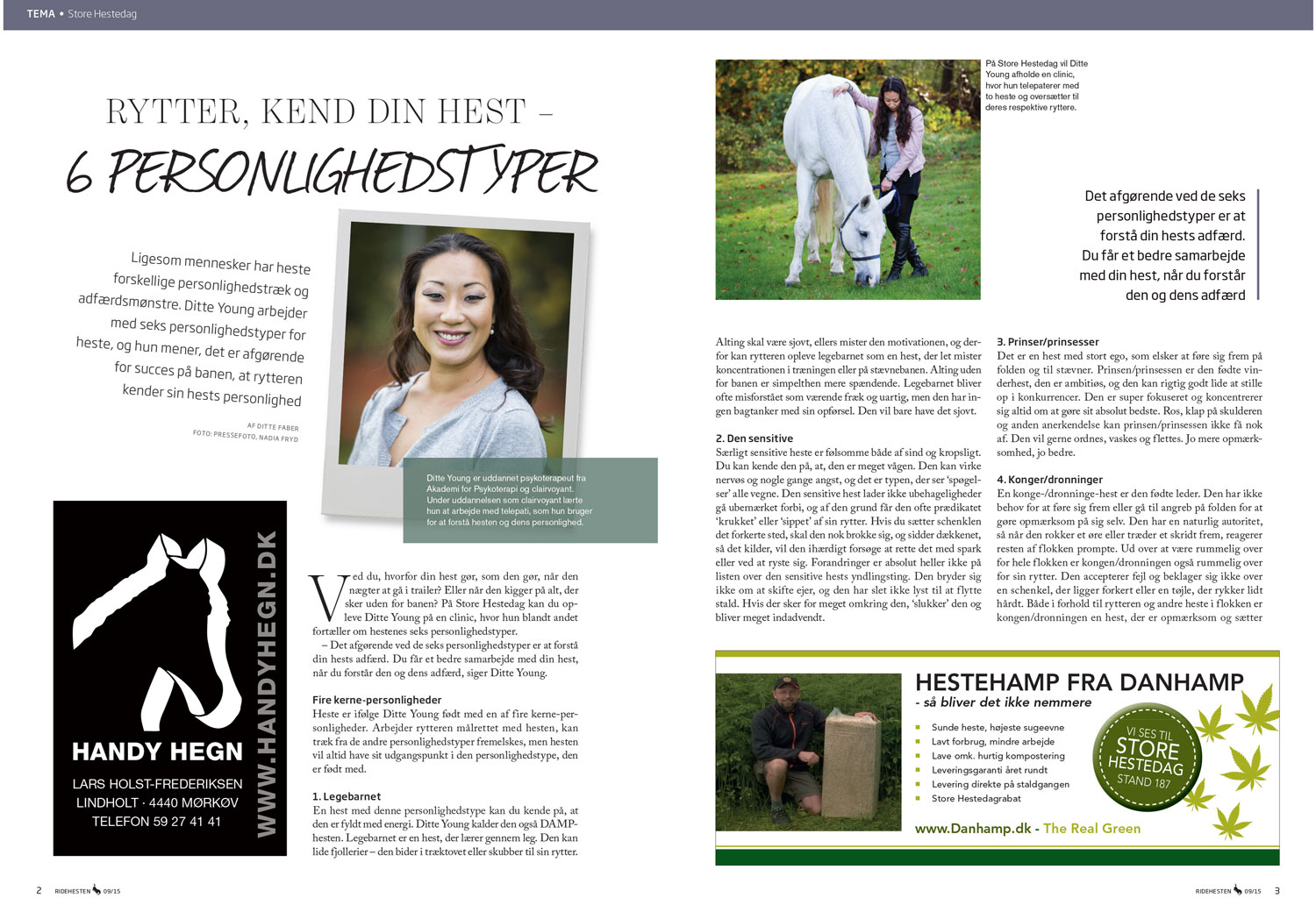
Do you know why your horse acts the way it does when it refuses to load into a trailer? Or why it stares at everything happening outside the arena? At “Store Hestedag” (The Big Horse Day), you can attend a clinic with Ditte Young, where she discusses topics including the six personality types found in horses.
“The key to these six personality types lies in understanding your horse’s behavior. You achieve a better partnership with your horse when you understand it and its behavior,” says Ditte Young.
According to Ditte Young, horses are born with one of four core personality types. While a rider can work purposefully to cultivate traits from other personality types, the horse will always remain rooted in the personality type with which it was born.
You can recognize a horse with this personality type by its abundance of energy. Ditte Young also refers to it as the “ADHD horse.” The Playful One learns through play. It enjoys a bit of horseplay—nibbling on lead ropes or nudging its rider.
Everything must be fun; otherwise, the horse loses its motivation. Consequently, riders of such horses may find that their mounts easily lose focus during training or in the competition ring—after all, everything happening outside the arena is simply more exciting. The Playful One is often misunderstood as cheeky or naughty, but its behavior has no ulterior motive; it simply wants to have fun.
Highly sensitive horses are delicate in both mind and body. You can identify them by their high level of alertness. It may appear nervous and sometimes anxious, and it is the type that sees “ghosts” everywhere. The sensitive horse does not let unpleasant sensations go unnoticed; for this reason, its rider often labels it “fussy” or “touchy.” If you apply your leg aid in the wrong spot, it will make its displeasure known; if a rug sits in a way that tickles, it will persistently try to fix it by kicking out or shaking its body.
Furthermore, changes are definitely not on the sensitive horse’s list of favorite things. It dislikes changing owners, and it certainly has no desire to move to a new stable. If there is too much activity around it, it will “shut down” and become very withdrawn.
This is a horse with a big ego that loves to show off in the paddock and at competitions. The prince or princess is a born winner; it is ambitious and truly enjoys competing. It is super focused and always concentrates on doing its absolute best. The prince or princess can never get enough praise, pats on the shoulder, or other forms of recognition. It enjoys being groomed, washed, and having its mane braided. The more attention, the better.
A “king” or “queen” horse is a born leader. It has no need to show off or act aggressively in the paddock to draw attention to itself. It possesses a natural authority, so when it twitches an ear or takes a single step forward, the rest of the herd reacts immediately. In addition to being tolerant of the entire herd, the king/queen is also tolerant of its rider. It accepts mistakes and does not complain about a leg aid that is applied incorrectly or a rein that is pulled a bit too hard. Both in relation to the rider and to other horses in the herd, the king/queen is an attentive horse that sets others’ needs above their own. A nudge with the muzzle when the rider is sad is one of the king/queen’s ways of showing care for their rider.
According to Ditte Young, in addition to the core personality types, horses can develop two other personality types as a result of negative experiences.
Regardless of which of the four core personality types a horse has, shock or traumatic experiences can lead to behavioral problems. You might notice this if, for example, the horse kicks violently in its stall or refuses to load into a trailer. This problematic behavior overshadows the horse’s true personality traits—whether it is naturally sensitive, playful, a “prince/princess,” or a “king/queen.” The biggest challenge for horses in this category is that the rider may be unaware of the underlying causes of the negative behavior. Without understanding the horse, the rider often becomes frustrated and angry instead of helping the horse overcome its trauma. This creates a vicious cycle in which the horse’s negative behavior persists.
This type of horse lacks forward momentum. It does not respond to the rider’s leg aids, feels heavy to handle, and appears completely “switched off.” Like the horse affected by shock or trauma, a “rigid/lazy” horse actually possesses one of the four core personality types; however, it has lost its spark—perhaps due to being trained too harshly, incorrectly, or in a monotonous way. This could apply to a riding school horse, or a horse with a natural talent for show jumping that is being forced to perform only dressage. If the rider succeeds in restoring the horse’s motivation, one of the four core personalities will resurface; only then can the training truly begin. The major problem arises if the rider fails to realize that this lack of motivation is the actual challenge.
If the rider does not understand the horse’s personality type, they risk causing the horse to develop one of the two experience-based personalities—a result of a relationship defined by misunderstandings and conflict.
All four core personality types are capable of top-level performance in competitive sports. While the “Prince” or “Princess” type is arguably the most naturally motivated to compete, the “Playful” type or the “Sensitive” type could just as easily end up with the most gold medals.
“It’s not that the ‘Playful’ type, for instance, doesn’t want to win or compete. They do—but in a specific way and within a specific framework,” says Ditte Young.
Once you understand what is required to motivate a particular core personality to train and perform, the results will follow. Ditte Young highlights another equally important benefit of knowing and understanding your horse’s personality: you can show respect, which fosters a stronger bond—and a happier horse.
Sign up for my newsletter and receive the free animal telepathy course “10 tips for communicating telepathically with your animal”