
Original Publication: The Riding Horse Magazine, (Ridehesten.com)
Publication Date: February 2017 (02/2017)
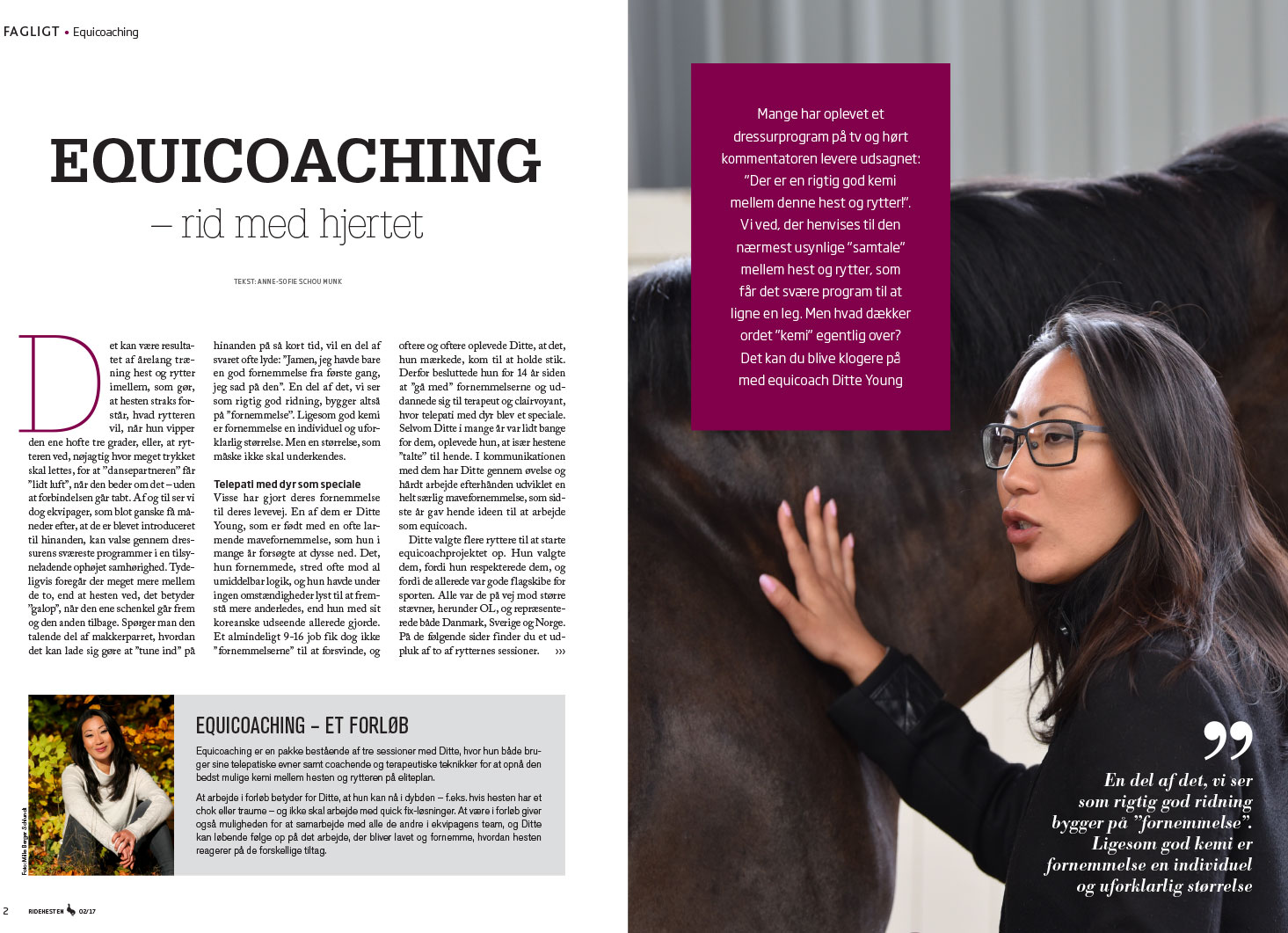
Many have watched a dressage test on TV and heard the commentator remark: “There is really good chemistry between this horse and rider!” This refers to the almost invisible “conversation” between horse and rider—one that makes a difficult routine look like child’s play. But what does the word “chemistry” actually entail? You can find out more with equicoach Ditte Young.
It can be the result of the training between horse and rider, allowing the horse to immediately understand what the rider wants when she shifts one hip just three degrees—or the rider to know exactly how much pressure to release so that her “dance partner” gets “a little breathing room” when it asks for it, without losing the connection. Every now and then, we see horse-and-rider combinations who, just a few months after being introduced to one another, can glide through the most difficult dressage tests with an apparently extraordinary sense of harmony.
Clearly, there is much more going on between the two than simply the horse knowing that “canter” means moving one leg forward while the other moves back. If you ask the human half of the partnership how they manage to “tune in” to one another in such a short time, part of the answer will often sound something like this: “Well, I just had a good feeling about the horse from the very first time I rode it.”
In other words, much of what we recognize as truly excellent riding is based on “feel.” Just like chemistry and intuition, feel is something individual and difficult to explain. But perhaps it is something we should not underestimate.
Some people have turned their intuition into a way of life. One of them is Ditte Young, who was born with a gut feeling that was often impossible to ignore, though she spent many years trying to quiet it. What she sensed often ran counter to immediate logic, and she had no desire to stand out any more than she already did because of her distinctive appearance.
However, an ordinary nine-to-five job did nothing to make her “intuitions” disappear. More and more often, Ditte found that what she sensed proved true. Fourteen years ago, she therefore decided to follow her intuition and trained as a therapist and clairvoyant, specializing in telepathy with animals.
Although Ditte had been somewhat afraid of animals for many years, she discovered that horses, in particular, seemed to “talk” to her. Through practice and hard work, her communication with them gradually helped her develop a very special intuitive ability. Last year, this inspired her to begin working as an equicoach.
Ditte selected several riders to launch the equicoaching project. She chose them because she respected them and because they were already excellent ambassadors for the sport. All of them were working toward major competitions, including the Olympics, and represented Denmark, Sweden, and Norway.
On the following pages, you will find excerpts from sessions with two of the riders.
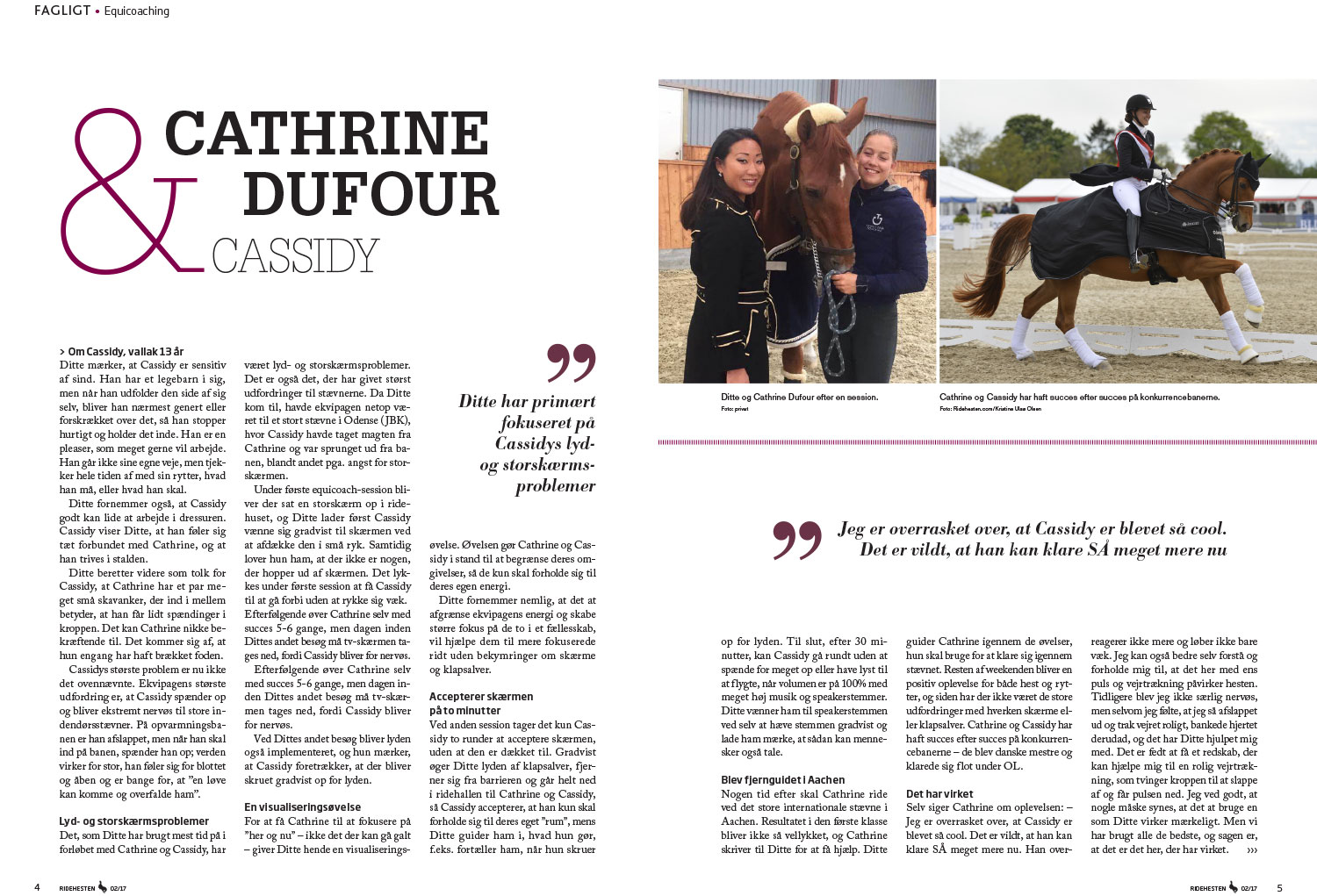
Equicoaching is a package consisting of three sessions with Ditte, during which she uses her telepathic abilities alongside coaching and therapeutic techniques to achieve the best possible relationship between horse and rider.
Working through a series of sessions allows Ditte to explore underlying issues in greater depth, such as whether a horse has experienced shock or trauma and whether the rider has problems with mental focus.
It also creates opportunities for collaboration with other members of the horse-and-rider team’s support network.
Ditte can follow the work being done, which helps her understand how the horse responds to different measures.
About Cassidy, a 13-year-old gelding
Ditte points out that Cassidy is sensitive by nature. He has a playful side, but when he shows it, he can become almost shy or frightened, so he quickly stops and holds it in.
He is a pleaser who loves to work. He doesn’t go his own way but keeps checking with his rider what he needs to do and where he needs to go.
Ditte also senses that Cassidy likes to work in the dressage arena. Cassidy shows Ditte that he feels closely connected to Cathrine and enjoys being in the stable.
Acting as an interpreter for Cassidy, Ditte further explains that Cathrine has a couple of very minor issues that occasionally cause him to develop tension in his body. Cathrine can confirm this. It stems from the fact that she once broke her foot.
Cassidy’s biggest problem, however, is not the one mentioned above. The pair’s greatest challenge is that Cassidy tenses up and becomes extremely nervous at large indoor shows. He is relaxed in the warm-up arena, but as soon as he enters the competition arena, he tenses up; the world seems too big, he feels too exposed and vulnerable, and he is afraid that “a lion might come and attack him.”
Throughout her work with Cathrine and Cassidy, Ditte has spent most of her time addressing issues related to sound and large screens. These have also proven to be the greatest challenges during competitions.
When Ditte first became involved, the pair had just returned from a major competition in Odense (JBK), where Cassidy had taken control from Cathrine and jumped out of the arena—partly because of fear of the large screen.
During the first equicoaching session, a large screen is set up in the indoor arena, and Ditte first lets Cassidy gradually get used to it by uncovering it in small stages. At the same time, she reassures him that nothing will jump out of the screen. During this first session, they get Cassidy to walk past it without shying away.
Afterward, Cathrine practices on her own 5–6 times with success, but the day before Ditte’s second visit, they have to take down the TV screen because Cassidy becomes too nervous.
During Ditte’s second visit, she also introduces sound, and she notices that Cassidy prefers the volume to be turned up gradually.
To help Cathrine focus on the “here and now”—rather than on what might go wrong—Ditte gives her a visualization exercise. The exercise helps Cathrine and Cassidy narrow their focus, limiting their awareness of their surroundings so they can focus only on their own energy.
Ditte senses that channeling the pair’s energy and fostering a greater sense of connection between them will help achieve more focused rides—free from concerns about screens or applause.
By the second session, it takes Cassidy only two rounds to accept the screen, even when it is left uncovered. Gradually, Ditte increases the applause volume, moves away from the barrier, and walks down into the arena to join Cathrine and Cassidy. This helps Cassidy learn to focus solely on their own “space,” while Ditte guides him through her actions—for instance, letting him know whenever she turns up the volume.
Finally, after 30 minutes, Cassidy can move around without becoming overly tense or feeling the urge to flee, even with the volume at 100%—featuring very loud music and the voices of announcers.
Ditte helps him get used to the announcer’s voice by gradually raising her own voice, showing him that this is also a way humans can speak.
Sometime later, Cathrine was set to compete at the major international horse show in Aachen. The result in the first class did not go well, so Cathrine reached out to Ditte for help.
Ditte guided Cathrine through the exercises she needed to get through the competition. The rest of the weekend was a positive experience for both horse and rider, and since then, there have been no major issues with screens or applause.
Cathrine and Cassidy have enjoyed one success after another in the competition arena—they became Danish champions and performed impressively at the Olympics.
Reflecting on the experience, Cathrine says:
“I’m surprised at how cool-headed Cassidy has become. It’s incredible that he can handle SO much more now. He no longer overreacts or simply bolts away. I’ve also come to better understand how my heart rate and breathing affect the horse.
I didn’t used to get particularly nervous, but even when I looked relaxed and breathed calmly, my heart would pound—and Ditte has helped me with that.
It’s great to have a tool that helps me breathe calmly, forces my body to relax, and lowers my heart rate. I know some might find it strange to work with someone like Ditte. But we’ve worked with the very best, and the fact is, this is what actually worked.”
About Tailormade Tahennya (“Henny”), an 11-year-old mare
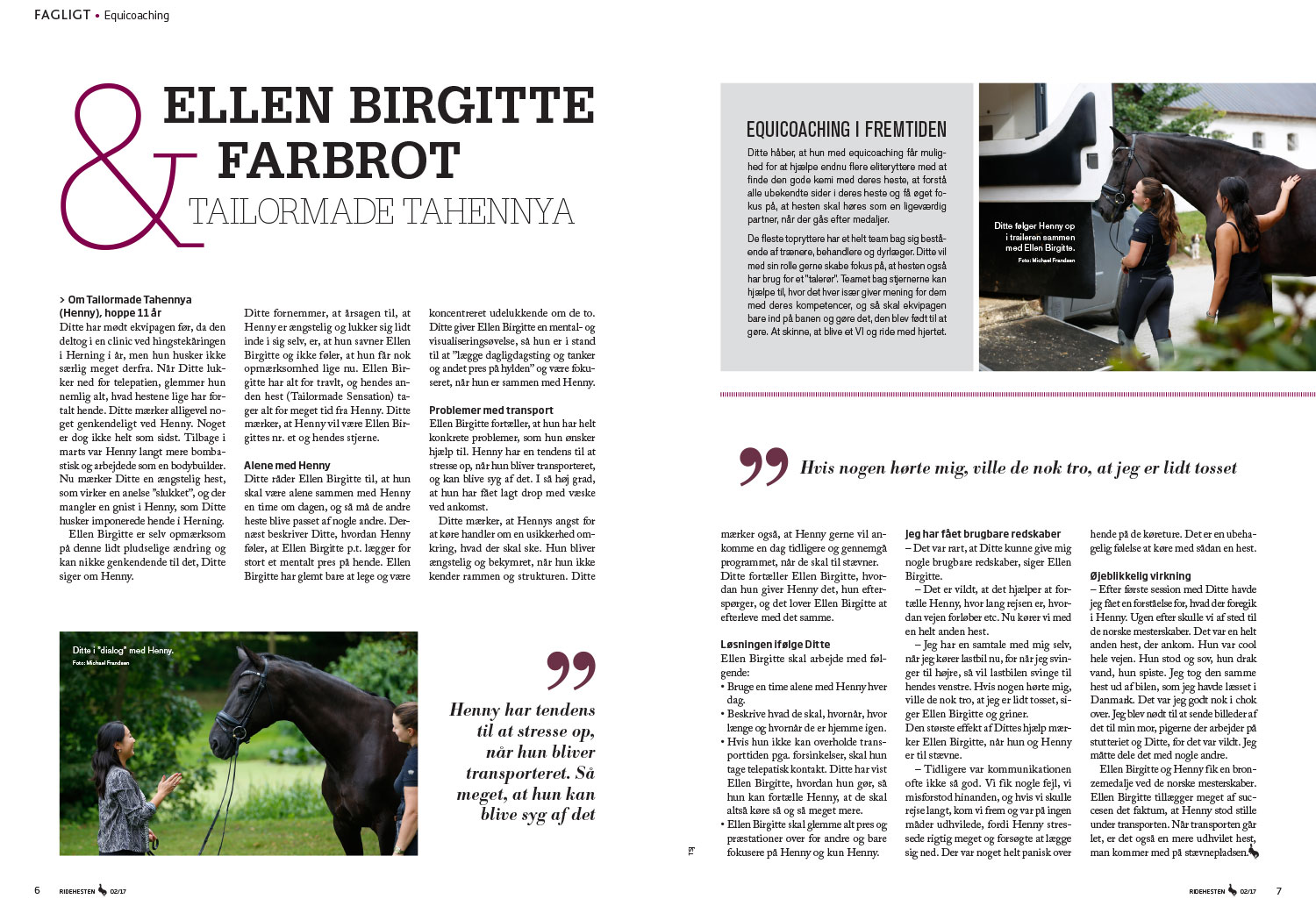
Ditte has encountered this horse-and-rider pair before—during a clinic at the stallion licensing in Herning earlier this year—though she doesn’t recall much from that occasion. In fact, once Ditte switches off her telepathic connection, she forgets everything the horses have just told her. Nevertheless, Ditte senses something familiar about Henny. Yet, things are not quite the same as they were last time. Back in March, Henny was far more bombastic, moving like a bodybuilder. Now, Ditte senses an anxious horse who seems somewhat “switched off”; the spark that impressed Ditte in Herning is missing.
Ellen Birgitte is aware of this sudden shift and readily recognizes Ditte’s observations about Henny.
Ditte senses that the reason for Henny’s anxiety—and her tendency to withdraw into herself—is that she misses Ellen Birgitte and feels she isn’t receiving enough attention right now. Ellen Birgitte is simply too busy, and her other horse (Tailormade Sensation) is taking up far too much time that could be spent with Henny. Ditte senses that Henny wants to be Ellen Birgitte’s number one—her star.
Ditte advises Ellen Birgitte to spend one hour a day alone with Henny, leaving the care of the other horses to someone else. Ditte also explains that Henny feels Ellen Birgitte is currently putting too much mental pressure on her. Ellen Birgitte has forgotten how to simply play and focus exclusively on the two of them.
Ditte gives Ellen Birgitte a mental visualization exercise to help her “set aside daily concerns, thoughts, and other pressures,” so she can stay focused when she is with Henny.
Ellen Birgitte explains that she faces specific challenges and needs help. Henny tends to become stressed during transport—to the point of getting physically ill. It has even reached a stage where Henny has required an IV drip for fluids upon arrival.
Ditte senses that Henny’s travel anxiety stems from uncertainty about what will happen. She becomes anxious and worried when she doesn’t know the framework or structure. Ditte also senses that, when attending competitions, Henny would prefer to arrive a day early to go over the schedule. Ditte explains to Ellen Birgitte what Henny needs, and Ellen Birgitte promises to implement it immediately.
Ellen Birgitte needs to work on the following:
– Spend one hour alone with Henny every day.
– Explain what they are going to do, when, for how long, and when they will be back home.
– If she cannot adhere to the planned travel time due to delays, she should make telepathic contact. Ditte has shown Ellen Birgitte how to do this, so she can tell Henny they will be traveling a bit longer.
– Ellen Birgitte must let go of all pressure and concerns about performance in the eyes of others, focusing solely on Henny—and only Henny. I’ve gained useful tools
“It was great that Ditte could provide me with some useful tools,” says Ellen Birgitte.
“It’s incredible how much it helps to tell Henny about the journey—how long it will take, what the route is like, and so on. We’re traveling with a completely different horse now.”
“I actually talk to myself while driving the horse truck; when I turn right, the truck turns to her left. If anyone heard me, they’d probably think I was a bit crazy!” Ellen Birgitte says with a laugh.
Ellen Birgitte notices the biggest impact of Ditte’s help when she and Henny are at competitions.
“In the past, our communication often wasn’t great. We’d make mistakes, misunderstand each other, and if we had to travel a long distance, we’d arrive completely exhausted—Henny would get extremely stressed and even try to lie down. She would get absolutely frantic during those trips. It’s a really unpleasant feeling to travel with a horse like that.”
“After my first session with Ditte, I finally understood what was going on inside Henny. The following week, we set off for the Norwegian Championships. The horse that arrived was a completely different animal. She was calm the entire way—she stood there sleeping, drank water, and ate. I took the exact same horse out of the truck that I had loaded in Denmark. I was honestly in shock! I had to send photos to my mother, the girls working at the stud farm, and Ditte—it was just incredible. I simply had to share it with someone.” Ellen Birgitte and Henny won a bronze medal at the Norwegian Championships. Ellen Birgitte attributes much of this success to Henny staying calm during transport. When the journey goes smoothly, the horse arrives at the competition venue well-rested.
Through equicoaching, Ditte hopes to help even more elite riders establish a strong rapport with their horses—understanding the unknown aspects of their equine partners—and to place greater emphasis on treating the horse as an equal partner when striving for medals.
Most top riders have an entire team behind them, consisting of trainers, therapists, and veterinarians. In her role, Ditte wants to highlight that the horse, too, needs a “voice.” The team behind the stars can contribute in ways that align with their individual areas of expertise—leaving the horse-and-rider pair free to simply enter the arena and do what they were born to do: shine, become a unified “we,” and ride from the heart.
Sign up for my newsletter and receive the free animal telepathy course “10 tips for communicating telepathically with your animal”