
Original Publication: Hose & Rider Magazine (Hest & Rytter), Denmark
Publication Date: March 2011
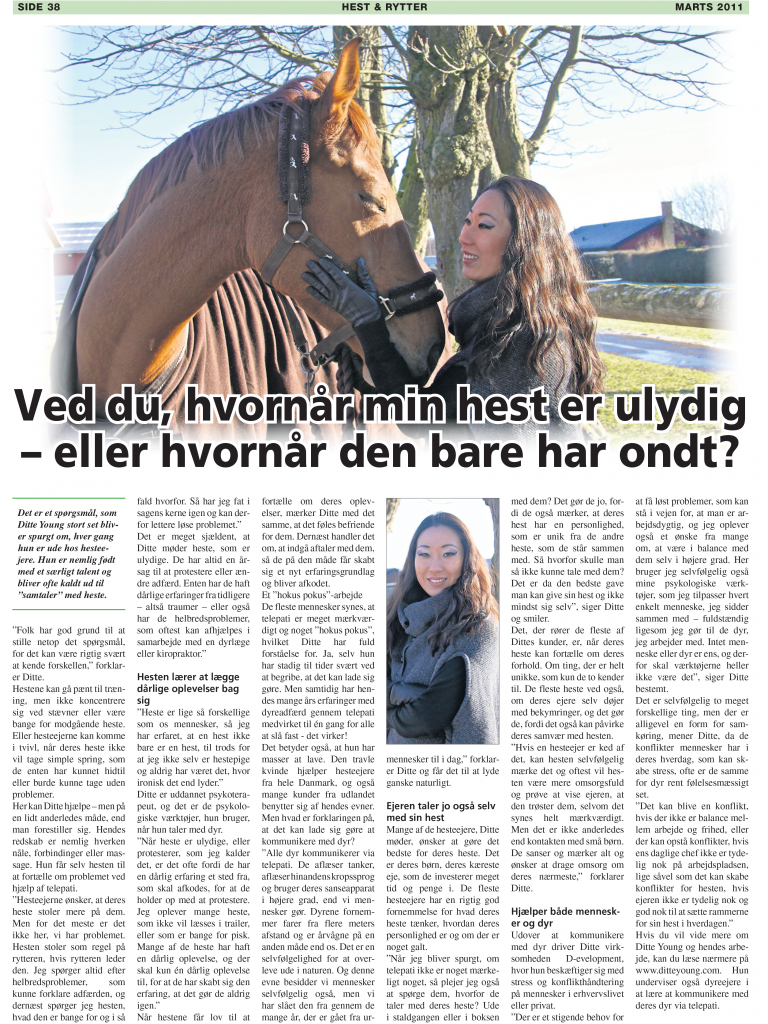
Ditte Young is asked this question almost every time she visits horse owners. She was born with a special talent and is often called upon to have “conversations” with horses.
“People have good reason to ask that question because it can be very difficult to tell the difference,” Ditte explains.
Horses may resist training, refuse to concentrate when jumping obstacles, or be afraid of approaching horses. Horse owners may also become uncertain when their horses refuse to perform simple jumps they previously managed without any problems.
Ditte can help, but in a somewhat different way than one might imagine. Her tool is neither needles, bandages, nor massage. She gets the horse to explain the problem through telepathy.
“Horse owners want their horses to trust them more. But for that to happen, they need a relationship of trust. The horse generally trusts the rider if the rider leads it. I always ask about health problems that might explain the behavior, and then I ask the horse what it is afraid of and, if so, why. In this way, I have gotten to the heart of the matter many times and subsequently been able to solve problems more easily.”
Ditte rarely encounters horses that are simply disobedient. They always have a reason to protest or change their behavior. Either they have had bad experiences with previous owners — in other words, trauma — or they have health problems that can often be treated in collaboration with a veterinarian or chiropractor.
“Horses are just as different as people, and I have experienced that a horse is not simply a horse, even though I am not personally a horse enthusiast and never have been, however ironic that may sound.”
Ditte is a trained psychotherapist, and it is the psychological tools she uses when communicating with animals.
“When horses are disobedient or protest, as I call it, it is often because they have had a bad experience somewhere in their past that needs to be resolved so that they stop protesting.
“I encounter many horses that do not want to be loaded into trailers or that are afraid of whips. Many of these horses have had an unpleasant experience, and it may take only one bad experience for them to develop a lasting fear.
“When horses are allowed to talk about their experiences, Ditte notices that it feels liberating for them. Then the process involves making agreements with them, so they can develop a new foundation of experiences, and the problem can be resolved.”
Most people believe that telepathy is very strange and something like “hocus-pocus,” which Ditte fully understands.
Yes, she still sometimes finds it difficult to believe it is possible. But at the same time, her many experiences with animal behavior through telepathy have convinced her once and for all that it works.
This also means that she has plenty to do. The busy woman helps horse owners from all over Denmark, and she also has many clients abroad who use her abilities.
But how can she communicate with animals?
“All animals communicate through telepathy. They read thoughts, read each other’s body language, and use their senses in ways that humans do not.
“Animals sense danger from several meters away and are alert in a completely different way than we are.
“It is a survival mechanism for living in the wild.
“And this ability also exists in us humans, but we have switched it off over the years because we have too many people around us today,” Ditte explains, making it all sound quite natural.
Many of the horse owners Ditte meets want the very best for their horses.
They are their children, their dearest possessions, and they invest a great deal of time and money in them.
Most horse owners have a very good sense of what their horses are thinking, what their personalities are like, and whether something is wrong.
“When I am asked whether telepathy is something extraordinary, I usually ask them why they talk to their horses when they are standing alone in the stable with them.
“They do so because they can also sense that their horse has a personality that is unique compared with the other horses around it.
“So why shouldn’t they be able to communicate with them?
“The best gift you can give your horse is not to lose yourself,” Ditte says with a smile.
What touches most of Ditte’s clients is when their horses can talk about their relationships—about things that are completely unique and that only the two of them know.
Most horses also know whether their owners are worried, and this makes them concerned too, because it can affect their relationship with the horse.
“If a horse owner is sad about something, the horse can naturally sense it and will often be more caring and try to show its owner that it finds the situation remarkable.
“But this is no different from contact with small children. They also sense and notice everything and want to care for those closest to them,” Ditte explains.
In addition to communicating with animals, Ditte runs the company D-evelopment, where she works with stress management and conflict management for people in business or private life.
“There is an increasing need to solve problems that can arise because people are too ambitious, and I also experience a desire among many people to find greater balance within themselves.
“Here, of course, I also use my psychological tools, which I adapt to each individual person.
“I work together with people in exactly the same way as I do with animals.
“Whether it is people or animals, the tools must not be different,” Ditte firmly states.
Of course, these are two very different things, but Ditte believes they share a common connection because the conflicts people experience in everyday life can create stress, often in the same way for animals from an emotional perspective.
“It can become a conflict if there is no balance between work and leisure, or conflicts can arise if a person’s immediate supervisor is not clear enough in the workplace.
“Similarly, conflicts can arise for the horse if its owner is not clear and capable enough of setting boundaries for the horse in everyday life.”
If you would like to learn more about Ditte Young and her work, you can visit www.ditteyoung.com.
She also teaches animal owners how to communicate with their animals through telepathy.
Sign up for my newsletter and receive the free animal telepathy course “10 tips for communicating telepathically with your animal”