
Original Publication: The Riding Horse Magazine (Ridehesten), Denmark
Publication Date: May 2010 (05/10)
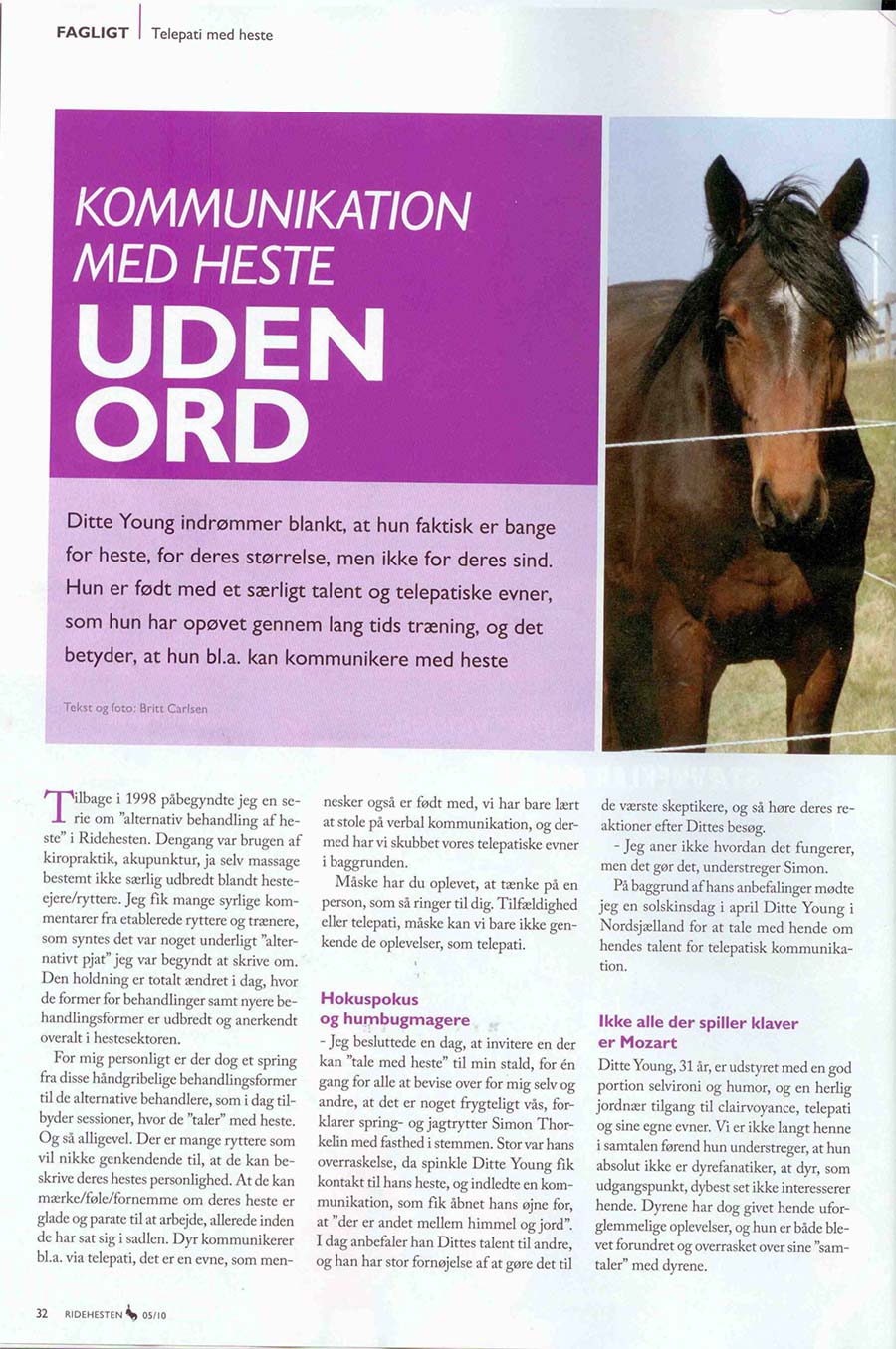
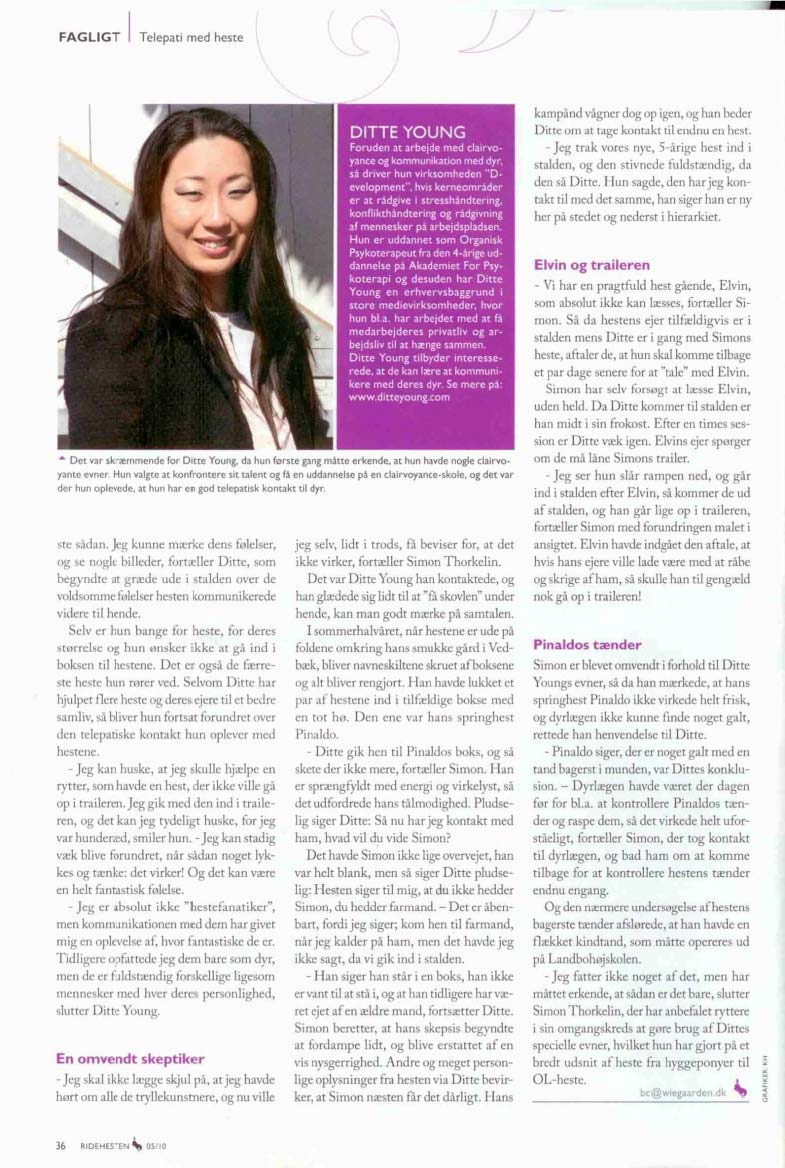
Ditte Young readily admits she is afraid of horses because of their size, not their minds. She was born with a special talent and telepathic abilities that she has refined through extensive training, enabling her, among other things, to communicate with horses.
Back in 1998, I began a series about alternative treatments for horses in Ridehesten. At that time, chiropractic treatment, acupuncture, and even massage were certainly not widespread among horse owners and riders. Established riders and trainers often gave me sarcastic comments, thinking the alternative nonsense I’d started writing about was strange. That attitude has changed completely today, when these forms of treatment, along with newer methods, are widespread and recognized throughout the equestrian industry.
Personally, however, I still find a considerable leap between these tangible treatment methods and alternative practitioners who now offer sessions in which they “talk” to horses. Yet many riders will recognize that they can describe their horses’ personalities and sense whether they’re happy and ready to work, even before getting into the saddle.
Animals communicate through telepathy, among other things. Humans are born with this ability too, but we have learned to rely on verbal communication and have pushed our telepathic abilities into the background.
Perhaps you have experienced thinking about someone who then calls you. Coincidence or telepathy? Perhaps we simply fail to recognize such experiences as telepathy.
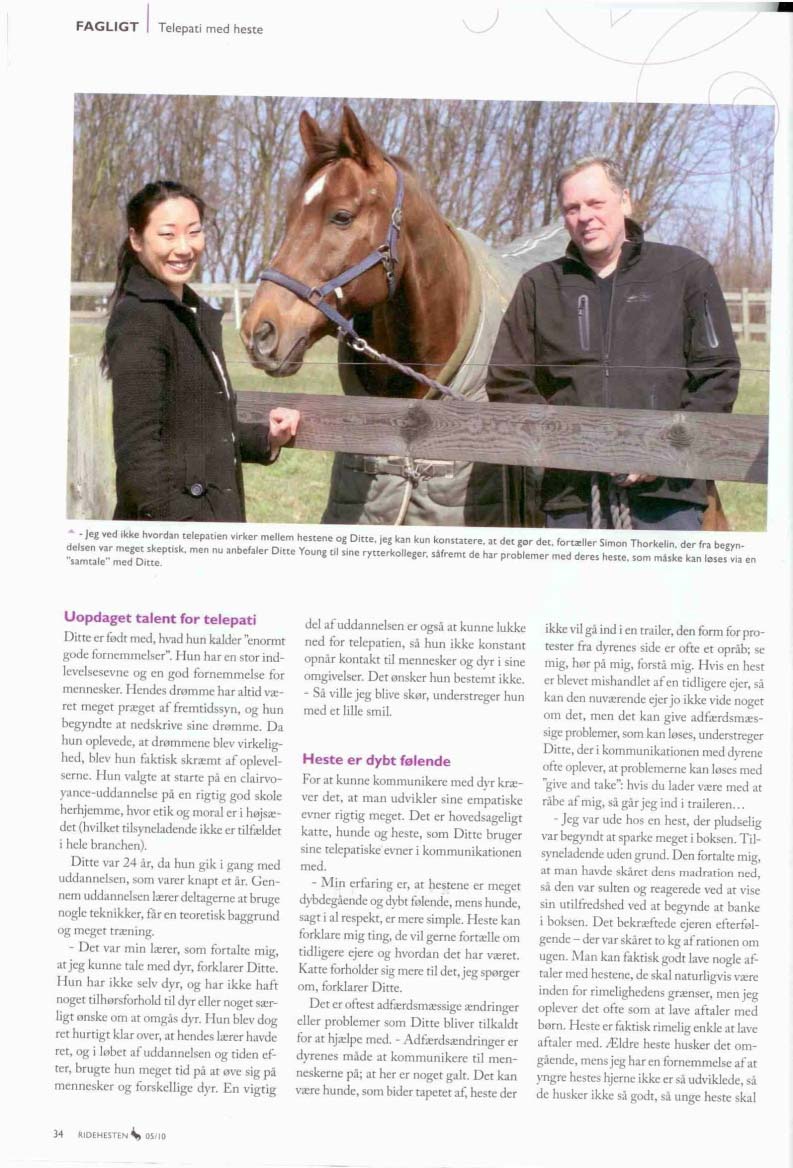
“I decided one day to invite someone who could ‘talk to horses’ to my stable, once and for all to prove to myself and others that it was complete nonsense,” explains show jumper and hunter rider Simon Thorkelin firmly. He was greatly surprised when the petite Ditte Young established contact with his horses and began a conversation that opened his eyes to the possibility that there is more between heaven and earth.
Today, he recommends Ditte’s abilities to others and takes great pleasure in introducing even the most skeptical people to her work and hearing their reactions afterward.
“I have no idea how it works, but it does,” Simon emphasizes.
On his recommendation, I met Ditte Young in North Zealand on a sunny day in April to talk with her about her talent for telepathic communication.
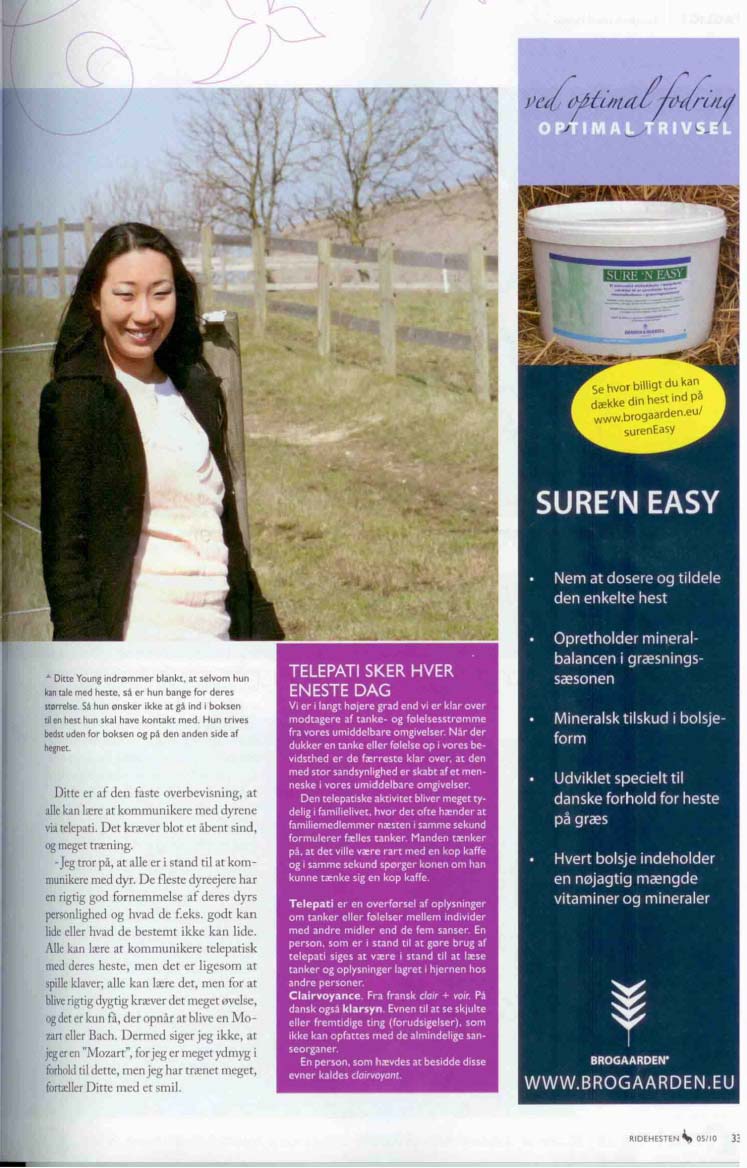
Ditte Young, 31, has a healthy dose of self-irony and humor, along with a wonderfully down-to-earth approach to clairvoyance, telepathy, and her own abilities. We are not far into our conversation before she emphasizes that she is certainly not an animal fanatic and that animals, in principle, do not particularly interest her. Nevertheless, animals have given her unforgettable experiences, and she has been both astonished and surprised by her “conversations” with them.
Ditte firmly believes that everyone can learn to communicate with animals through telepathy. All it takes is an open mind and plenty of training.
“I believe everyone is capable of communicating with animals. Most animal owners have a very good sense of their animals’ personalities, what they like, and what they absolutely dislike. Everyone can learn to communicate telepathically with their horses, but it is like playing the piano. Everyone can learn, but becoming really good requires a great deal of practice, and only a few become Mozart or Bach. So, I am not saying that I am a ‘Mozart,’ because I am very humble about this, but I have practiced a great deal,” Ditte says with a smile.
Ditte was born with what she describes as “extremely strong intuitive abilities.” She has a great capacity for empathy and a good understanding of people. Her dreams have always been strongly characterized by visions of the future, and she began writing them down. When she saw her dreams become reality, she was actually frightened by them. She decided to enroll in a clairvoyance training program at a very good school in Denmark, where ethics and morality were held in high regard, something that apparently is not always the case throughout the industry.
Ditte was 24 when she began the program, which lasted almost a year. During the training, participants learned techniques, received a theoretical foundation, and practiced extensively.
“It was my teacher who told me that I could talk to animals,” Ditte explains.
She does not own animals and has never had a particular attachment to them or a strong desire to spend time with them. However, she quickly realized that her teacher was right, and during her training and afterward, she spent considerable time practicing her abilities with people and different animals. An important part of the training also involved learning to turn off her telepathic abilities so she wouldn’t constantly make contact with people and animals around her. She certainly did not want that.
“Otherwise, I would go crazy,” she emphasizes with a little smile.
Communicating with animals requires a high degree of empathy. Ditte primarily uses her telepathic abilities to communicate with cats, dogs, and horses.
“My experience is that horses are very profound and deeply sensitive, whereas dogs, with all due respect, are simpler.
“Horses can tell me things they want to share about previous owners and what their experiences were like. Cats tend to respond more specifically to the questions I ask,” Ditte explains.
Ditte is most often called upon to help with behavioral changes or problems.
“Behavioral changes are the animals’ way of communicating to people that something is wrong. It might be dogs that tear wallpaper off the walls or horses that refuse to enter a trailer. These kinds of protests from animals are often a cry for help: ‘See me, listen to me, understand me.’ If a horse has been mistreated by a previous owner, the current owner may know nothing about it, but it can create behavioral problems that can be resolved,” Ditte emphasizes.
In her communication with animals, she often finds that problems can be resolved through give-and-take.
“If you stop shouting at me, I will go into the trailer.”
“I once visited a horse that had suddenly started kicking violently inside its stall, apparently for no reason. The horse told me that its feed ration had been reduced, so it was hungry and was expressing its dissatisfaction by banging against the stall. The owner subsequently confirmed this. Two kilograms had been removed from the horse’s weekly feed ration. You really can make agreements with horses. Naturally, they have to be reasonable. I often experience it as making agreements with children. Horses are actually fairly easy to make agreements with. Older horses remember them, whereas I have the impression that younger horses’ brains are less developed, so they don’t remember quite as well. With young horses, you sometimes have to repeat the agreement several times before it becomes firmly established.”
“I don’t understand myself how telepathy is possible,” Ditte answers my question with a laugh.
“Animals are more sensitive than we are. It is an ability we have disconnected ourselves from. We, humans, relate to what we can see, feel, and hear, and therefore we do not actually use very much of our brain capacity.”
When Ditte communicates with horses, the communication takes place through images or feelings.
“If I ask you to close one of your kitchen cabinets in your mind and look at what is inside, that is how I see the images in my mind’s eye,” Ditte explains.
“If I ask a horse what it likes, I have experienced that it might send me an image of a jumping pole it jumps over, if it is a show jumper,” she adds.
Ditte’s task is then to communicate the images and feelings she receives to the horse’s owner in more concrete language. Ditte cares deeply about not simply telling the horse owner a meaningless story.
Often, she needs to explain further before the horse owner fully understands. Ditte isn’t particularly familiar with equestrian terminology, which sometimes leads to amusing situations. She understands what the images mean to the horse, but because her professional vocabulary is limited, explaining them to the owner can be challenging.
For example, she might use the word “foot” when referring to a hoof.
“Typically, I learn about the horse’s personality, everything it likes and dislikes. It can be anything from food to people, habits, previous owners, and much more. They also tell me about injuries, both past and present, and sometimes injuries that are developing. I am not a veterinarian, so a veterinarian must be brought in to examine the horse,” she emphasizes.
All she wants to know from the owner is the horse’s name. That is all she needs.
“In that way, I also appear more credible to the most skeptical people. Skepticism is healthy, but if it turns into resistance, you have to remain open to the possibility that there is more between heaven and earth.”
Through her communication with horses, Ditte has found that they have a very strict hierarchy, and that each horse knows exactly where it stands within it and whether it is being bullied by the other horses.
“I have also encountered horses that grieve over previous owners. In those situations, it is important to explain to them that they are going to stay where they are, and then a behavioral change occurs. If the owner truly means that the horse is going to stay, the horse senses that. If the owner breaks the agreement, the animal breaks it too. It is that simple.”
“Communicating with animals through telepathy is a very educational way of solving problems, so there is no need to resort to harsher methods. Solve the problem by allowing your horse to be heard. That is the best thing you can do for your animal.”
“I remember a horse that had been mistreated by a previous owner. It shocked me that someone could treat horses that way. I could sense its feelings and see some images,” Ditte explains.
She began crying in the stable because of the overwhelming emotions the horse communicated.
Although Ditte is afraid of horses because of their size and doesn’t want to enter their stalls, she has helped several horses and their owners build better relationships. Even so, she remains amazed by the telepathic contact she experiences with horses.
“I remember helping a rider whose horse would not go into a trailer. I went into the trailer with it, and I remember it very clearly because I was terrified,” she says with a smile. I can still be amazed when something like that succeeds, and I think, ‘It works!’ It can be a truly fantastic feeling.”
“I am definitely not a ‘horse fanatic,’ but communicating with horses has given me an understanding of how wonderful they are. Previously, I simply regarded them as animals, but they are completely different individuals, just like people, each with their own personality,” Ditte Young concludes.
“I won’t hide the fact that I had heard about all those magicians, and I wanted to prove for myself, almost out of spite, that it didn’t work,” Simon Thorkelin explains.
He contacted Ditte Young, and he looked forward to giving her a hard time during the session. One summer evening, while the horses were out in the paddocks around his beautiful farm in Vedbæk, he removed the nameplates from the stalls and cleaned everything. He had placed a couple of the horses in random stalls with hay. One of them was his show jumper Pinaldo.
“Ditte went over to Pinaldo’s stall, and then nothing happened,” Simon explains. The horse was full of energy and extremely lively, challenging his patience.
Suddenly, Ditte said, “Now I have contact with him. What would you like to know, Simon?”
Simon had not really considered that question and was completely unprepared.
Then Ditte suddenly said, “The horse tells me that you are not called Simon. You are called Farmand.”
“That is strange,” Simon replied, “because I say, ‘Come here to Farmand,’ when I call him, but I hadn’t said that when we went into the stable.”
“He says he is standing in a stall he is not used to, and that he previously belonged to an older man,” Ditte continued.
Simon explained that his skepticism had evaporated and been replaced by curiosity. Other highly personal information about the horse, conveyed through Ditte, made Simon almost feel uncomfortable. However, his competitive spirit returned, and he asked Ditte to contact another horse.
“I brought our new five-year-old horse into the stable, and a deep sense of surprise followed when Ditte looked at it. She said she had established contact immediately, and that he was new to the property and at the bottom of the hierarchy.”
“We have a wonderful horse, Elvin, who absolutely cannot be loaded into a trailer,” Simon explains.
Since the horse’s owner happened to be at the stable while Ditte was working with Simon’s horses, they arranged for her to return a few days later to “talk” with Elvin. Simon had tried to load Elvin himself, without success. When Ditte arrived at the stable, Simon was having lunch.
After an hour’s session, Ditte woke him up. Elvin’s owner asked whether they could borrow Simon’s trailer.
“I watched her lower the ramp and go into the stable to get Elvin. Then they came out of the stable, and he walked straight into the trailer,” Simon recalls, still astonished.
Elvin had agreed: if his owner stopped shouting and screaming at him, he would go into the trailer.
Simon has changed his opinion of Ditte Young’s abilities. When he noticed that his show jumper, Pinaldo, did not seem completely well, and the veterinarian found nothing wrong, he contacted Ditte.
“Pinaldo says there is something wrong with a tooth at the back of his mouth,” was Ditte’s conclusion.
“The veterinarian had been there the previous day to check Pinaldo’s teeth and file them, among other things, so it seemed completely incomprehensible,” Simon explained.
He contacted the veterinarian and asked him to return to re-examine the horse’s teeth. The closer examination of the back teeth revealed that Pinaldo had a cracked molar that had to be surgically removed at the Royal Veterinary and Agricultural University.
“I don’t understand any of it, but I’ve had to acknowledge that this is simply how it is,” concludes Simon Thorkelin.
He has recommended that riders in his circle use Ditte’s special abilities. She has worked with a wide variety of horses, from pleasure ponies to Olympic horses.
Sign up for my newsletter and receive the free animal telepathy course “10 tips for communicating telepathically with your animal”